


Double Pouching Risks for Nicotine Pouch Users: Use One Stronger Pouch
Double pouching is safe only when a manufacturer’s instructions for use explicitly allow it, and most nicotine pouches are not designed or tested for that. If your pouch’s IFU says nothing about stacking, the safer move is a correctly sized single pouch at the right strength. It is recommended to check product guidance before improvising with two.
TL;DR:
- Most nicotine pouches are not tested or designed for double pouching, making it a risky improvisation without manufacturer approval.
- Proper double pouching requires precise sizing, film orientation, and validated testing, which consumer products and home stacking do not meet.
- Doubling pouches can lead to nicotine overdose, pouch displacement, increased irritation, and mechanical damage, especially if done untrained.
- A high-strength single pouch designed for rapid nicotine release can safely provide more intake without stacking risks.
- User reports indicate discomfort, uneven nicotine release, and signs of overdose, particularly among inexperienced users experimenting with stacking.
Table of Contents
- What is double pouching and how is the technique actually validated?
- What do professional guidance and packaging labs actually say?
- What actually goes wrong when you double-pouch nicotine pouches
- How to get stronger nicotine delivery without doubling up
- Are there any situations where double pouching genuinely helps?
- Could doubling up damage the pouch material itself?
- What do nicotine pouch users actually report about double pouching?
- FUZE Team perspective: design choices and responsible use
- A stronger single pouch beats stacking two
- Sources
- FAQ
What is double pouching and how is the technique actually validated?
Double pouching started as a clinical sterilisation term: an inner pouch nested inside an outer pouch, both film-to-film, used to give hospital instruments a backup barrier during storage. Sterile processing teams don’t do this on instinct. Manufacturers test specific pouch combinations and specify, in writing, whether their product can serve as an inner or outer barrier. That written specification is the instructions for use, and it’s the only thing that turns double pouching from a guess into a validated technique.
Consumer nicotine pouches were never built with that kind of layered-barrier logic in mind. They’re engineered as single-use units, dosed, sized, and sealed to release nicotine at a specific rate through one pouch, not two. Borrowing a hospital packaging technique and applying it to something you put in your mouth ignores the fact that the entire safety case for clinical double pouching rests on:
- Manufacturer testing of that exact pouch pairing
- Documented film orientation and sizing rules
- Trained staff following a written protocol
None of that infrastructure exists for someone folding two nicotine pouches together at home.
What do professional guidance and packaging labs actually say?
Sterile processing bodies are consistent on one point: double pouching is conditional, never automatic. AORN’s guidance states that double pouching should only happen when the pouch manufacturer’s IFU explicitly permits it. That single condition governs everything else.
Packaging-test labs back this up with harder data. PackTalk’s lab perspective reports that double-barrier systems often outperform single barriers in validation testing, catching pinhole defects the outer layer alone would miss. But that improvement comes with strings attached:
- Inner and outer pouches must be sized correctly relative to each other
- Film-to-film orientation is mandatory. Get it backwards and you create new seal weaknesses
- Folding the inner pouch to fit introduces stress points that can fail under handling
A controlled study found no microbial contamination after three clinical uses and six months’ storage, but only when researchers applied rigorous inspection and monitoring throughout, according to research published in the European Journal of Dentistry. That result reflects a lab protocol, not something replicable by someone stacking pouches without training or oversight. Take the finding out of its controlled setting and it stops telling you anything useful about doing this yourself.
What actually goes wrong when you double-pouch nicotine pouches
Move from packaging theory to something you’re putting against your gum, and the risks change shape. Nicotine pouches aren’t sterile barriers. They’re dosed nicotine delivery products, and stacking two changes the maths in ways no manufacturer accounts for.
- Dosage stacking: two pouches worn together can push nicotine absorption well beyond what either pouch is calibrated for, raising overdose risk, particularly for anyone with lower tolerance or an existing heart condition
- Fit and choking risk: extra bulk shifts pouches out of position more easily, and that’s a genuine airway concern for anyone with a sensitive gag reflex or limited experience gauging pouch placement
- Pouch integrity and mucosal irritation: two pouches abrading against each other and your gum can retain more moisture, altering how quickly nicotine actually releases and increasing irritation
- Hygiene and reuse: folding or repositioning pouches to make two fit can damage the pouch structure and introduce contamination that a single, correctly placed pouch never faces
Pro Tip: If a pouch feels weak, the fix is a stronger single pouch, not a second pouch stacked on top of the first. Nicotine strength and pouch design aren’t separable variables.
How to get stronger nicotine delivery without doubling up
Reaching for two pouches usually means one thing: the single pouch you’re using isn’t matching what you need. That’s a strength problem, not a stacking problem, and it has a straightforward fix.
- Choose the correct strength first. If your current pouch feels too mild, move up to a higher-strength single pouch rather than adding a second one. Triple Mint 20mg is built as a single-pouch option for exactly this situation, delivering rapid-release nicotine without needing a second pouch stacked alongside it.
- Place it correctly. Tuck the pouch between your gum and lip, press gently so it sits flat, and avoid folding it to make it fit. A folded pouch changes how quickly it releases.
- Check comfort within the first minute. If it feels loose or oddly positioned, remove and reposition rather than adding a second pouch to hold it in place.
- Remove after the recommended time. Most pouches, including FUZE’s range, are designed to deliver their full flavour and nicotine profile within 30 to 60 minutes. Leaving one in longer, or adding another on top, doesn’t extend that window safely.
- Never reuse a single-use pouch. Once removed, dispose of it. Store unopened pouches in a cool, dry place away from direct heat, which keeps the pouch material and nicotine content stable until use.
Pro Tip: If you experience nausea, a racing heartbeat, dizziness, or a headache after using a pouch, stop immediately and seek medical advice. These are recognised signs of nicotine overdose, and pregnant people, those with cardiovascular conditions, and inexperienced users should avoid stacking pouches of any kind.
For general handling guidance and how nicotine pouches compare with other formats, this guide to using a nicotine pouch covers the basics worth knowing before you experiment with anything beyond a single pouch.
Are there any situations where double pouching genuinely helps?
There’s a narrow, honest answer here: it depends entirely on what problem you’re actually trying to solve.
If the goal is extended duration, doubling up isn’t the mechanism that gets you there safely. It just compresses two separate nicotine curves into overlapping absorption, which is unpredictable rather than extended in any controlled sense. A single, correctly dosed pouch designed to run 30 to 60 minutes achieves duration without the dosing uncertainty.
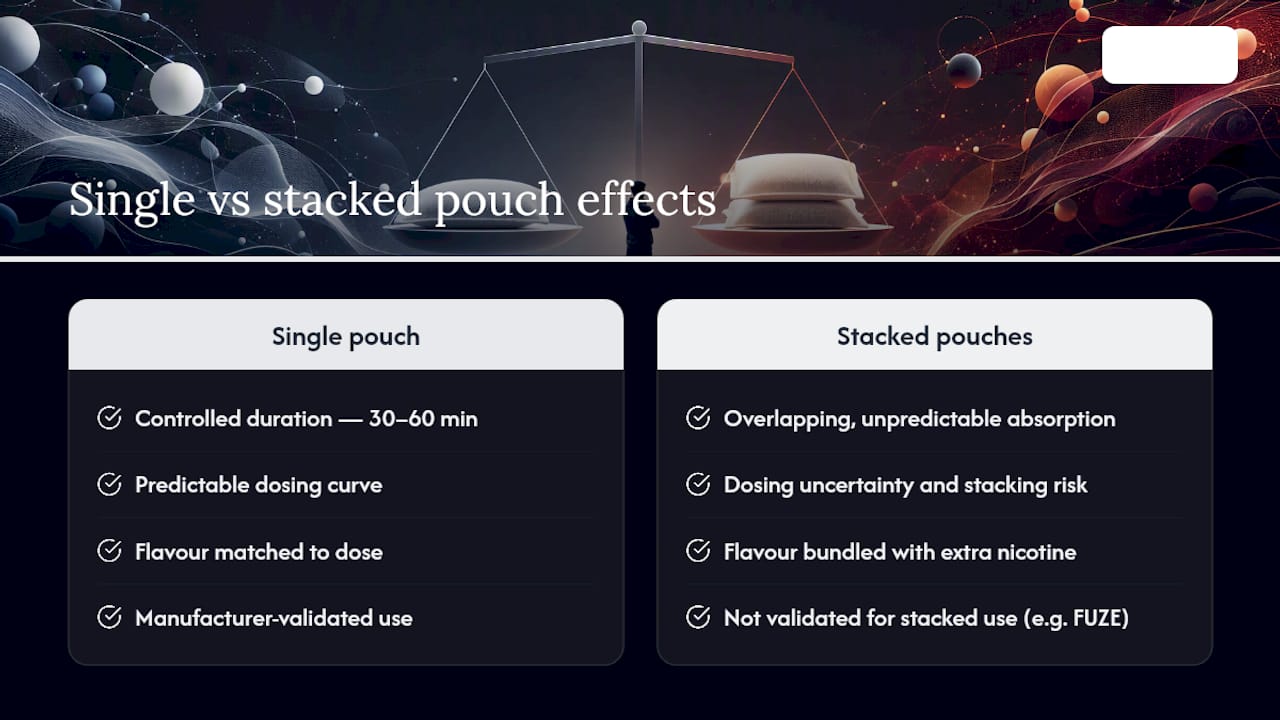
Flavour control is a slightly different case. Some users stack pouches hoping to blend flavour intensity, similar to how someone might mix two drinks to adjust taste. The problem is that nicotine release and flavour release aren’t separate systems in a pouch. You can’t isolate one from the other, so any flavour benefit comes bundled with the same dosage-stacking risk covered earlier.
That entire benefit depends on manufacturer validation existing in the first place. Nicotine pouch manufacturers, including FUZE, don’t validate their products for stacked use, so the clinical benefit case simply doesn’t transfer across. If you want a stronger sensation or longer-lasting flavour, the reliable route is choosing a pouch already built for that, not improvising a second layer the product was never tested with.
Could doubling up damage the pouch material itself?
Pouch material is engineered to release nicotine at a specific rate through one layer of fabric, one moisture profile, one mechanical structure. Introduce a second pouch pressed against it and you change several of those variables at once, none of them in ways the manufacturer tested for.
Moisture is the clearest issue. Nicotine pouches rely on controlled moisture content to release nicotine steadily. Two pouches pressed together retain more moisture against your gum than one would alone, and that changes the release curve unpredictably. It might release faster in the first few minutes and then taper off oddly, or it might do the opposite.
Mechanical stress matters too. Folding a pouch to make two fit comfortably stretches or creases the outer fabric, and that can create weak points where the pouch material breaks down faster than intended. A pouch that degrades unevenly doesn’t just taste different. It releases nicotine unevenly, which is precisely the unpredictability the AORN guidance and packaging labs both flag as the core risk of any unvalidated double-barrier arrangement.
There’s also a simpler, more direct problem: friction. Two pouches rubbing against each other and against soft tissue for 30 to 60 minutes increases abrasion, and abraded pouch material sheds fibres and residue into the mouth in a way a single, intact pouch doesn’t.
What do nicotine pouch users actually report about double pouching?
User accounts on nicotine pouch forums and community discussions tend to cluster around the same few complaints, and they’re consistent enough to be worth taking seriously even without a formal survey behind them.
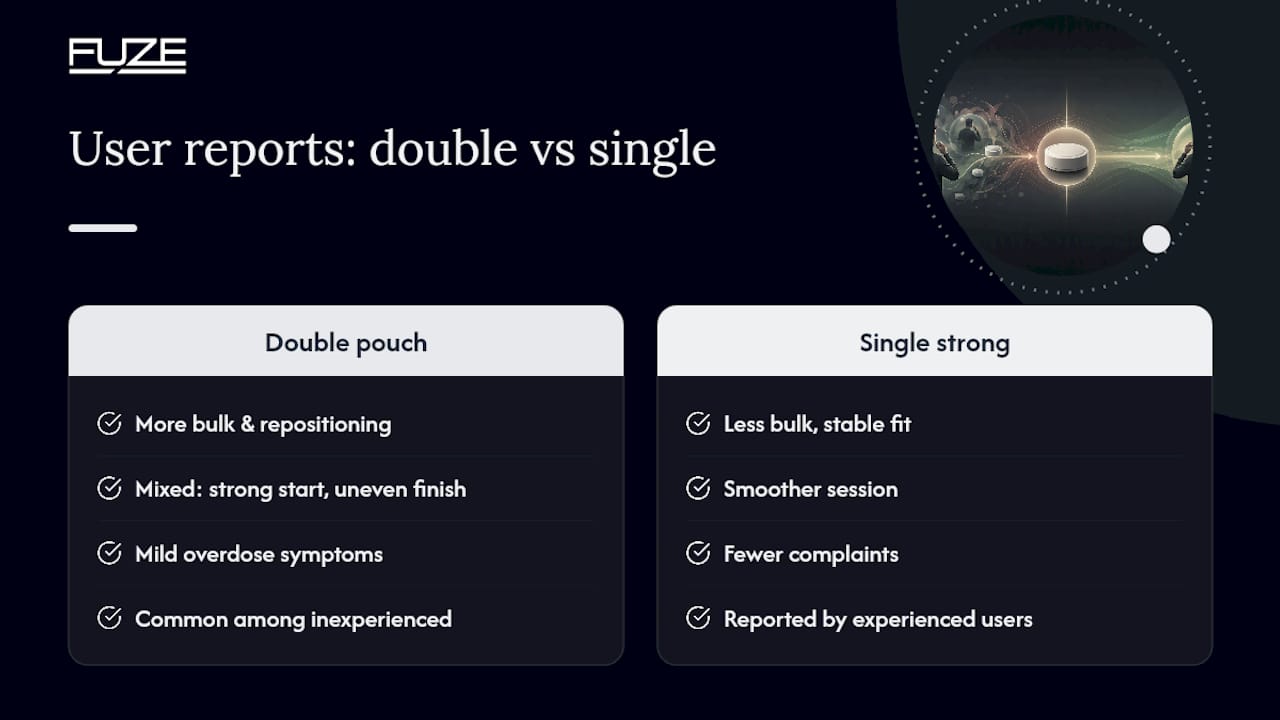
Comfort is the most common issue. Two pouches create noticeably more bulk against the gum, and several users describe needing to reposition constantly, which itself raises the fit and choking concerns covered earlier. Satisfaction reports are mixed at best. Some users report a stronger initial hit, which tracks with the dosage-stacking mechanism, but many also describe an unpleasant, uneven finish as the pouches degrade unevenly over the session.
Adverse event reports skew toward the milder end of the nicotine overdose spectrum: nausea, light-headedness, and a noticeably faster heartbeat. These are exactly the symptoms flagged in the safety steps above, and they appear disproportionately among people who describe themselves as inexperienced pouch users experimenting with stacking for the first time. Experienced users who deliberately choose stronger single pouches instead report far fewer of these complaints, which lines up with the practical alternative already covered: strength and pouch design, not quantity, is the variable worth adjusting.
None of this is peer-reviewed survey data, so treat it as a pattern in community reporting rather than a clinical finding. But the pattern is consistent enough, and consistent with the underlying mechanics, that it’s hard to dismiss.
FUZE Team perspective: design choices and responsible use
Some manufacturers build pouches around rapid-release, low-drip technology to reduce the need to improvise with two. A well-designed single pouch, correctly matched to your strength preference, does the job a stacked pair is trying to achieve, without the unpredictable dosing or fit problems that come with it. If you’re unsure which strength or format suits you, check the product instructions or contact the product support team directly. That’s a faster path to a better experience than guessing with a second pouch.
— FUZE Team
A stronger single pouch beats stacking two
If you’re reaching for a second pouch because one isn’t cutting it, Certain single-pouch products are built on rapid-release, low-drip technology, designed to deliver nicotine quickly and cleanly, with flavour lasting 30 to 60 minutes without the issues caused by pressing two pouches together.

Same-day delivery options may be available in some areas, allowing customers to receive products quickly without waiting to find a stronger option. If you’re not sure whether a particular strength is right for you, it’s advisable to contact the support team before purchase to discuss fit and strength questions, rather than finding out by trial. Head to the Triple Mint 20mg product page to compare it against what you’re currently using and order your next pouch the safer way.
This article is general information, not a substitute for advice from a qualified doctor. Consult a qualified healthcare professional about your own circumstances before acting on anything here.
Sources
- AORN (association guidance)
- Effects of resterilization and storage time on sterility of paper/plastic pouches — European Journal of Dentistry (PMC)
- Peeling back the mystery: package test lab perspective — PackTalk / Oliver HCP
FAQ
Is double pouching nicotine pouches safe?
It depends on the product’s instructions for use. Most nicotine pouches, including FUZE’s range, are designed for single-pouch use, and stacking two isn’t something manufacturers test for or recommend.
What happens if I double-pouch nicotine pouches?
You risk unpredictable nicotine absorption, pouch shifting that raises choking risk, and uneven release as the moisture and material properties of two pressed-together pouches change. Nausea, dizziness, and a racing heartbeat are signs it’s gone too far.
Is double pouching the same in hospitals as with nicotine pouches?
No. Clinical double pouching uses manufacturer-validated pouch pairings under a written protocol, following AORN guidance. Consumer nicotine pouches have no such validation for stacked use.
What should I do instead of double pouching for a stronger hit?
Choose a higher-strength single pouch designed for that purpose. Triple Mint 20mg is built as a stronger single-pouch option, avoiding the dosing unpredictability that comes with stacking two.
Can double pouching improve flavour or duration?
Not reliably. Nicotine release and flavour release aren’t separate in a pouch, so any flavour benefit from stacking comes with the same dosage-stacking risk, rather than a genuine, controlled extension of duration.
Recommended
- Tobacco-free Snus (Nicotine Pouches) vs Vapes
- Vapes vs Snus (Nicotine Pouches) in Ireland
- What is a Snus | Nicotine pouch and how do I use it?
This is for general information purposes only, not medical advice. Please consult your doctor if you have medical queries. This article may not be fully accurate or fully researched. Please do your own research and consult professionals before using nicotine. Nicotine is an addictive substance.