


Dry vs Moist Pouches: Science Backed Picks for Irish Users
Moist pouches deliver a quicker, front-loaded hit of flavour and nicotine because they’re already saturated with liquid when you put them in. Dry pouches take a couple of minutes to activate as your saliva does the work, but they usually last longer and drip far less. Neither format changes how much nicotine is actually in the pouch. The moisture level changes the speed and feel of the release, not the strength printed on the tin, and pH plays just as big a role as moisture in how strong something feels. Skip to the checklist below if you just want the shortcut.
TL;DR:
- Moist pouches deliver nicotine and flavor quickly within seconds to a minute, making them suitable for short-term use or quick hits.
- Dry pouches release nicotine more gradually over 30 to 60 minutes, providing a steadier experience ideal for long sessions or discreet use.
- The strength felt from a pouch depends heavily on pH and filler formulation, not just the milligram content on the label.
- Moisture content affects onset speed and flavor curve but does not change the total nicotine dose in the pouch.
- Choosing the right pouch depends on your desired speed, session length, discretion needs, and flavor experience.
Table of Contents
- Dry vs moist pouches at a glance
- How moisture actually changes onset, flavour and nicotine release
- Why ‘strength’ can feel different even with the same mg
- Managing comfort, drip and session length
- How moisture is measured, and what the numbers actually mean
- Choosing between dry and moist for your own use
- What ‘moist’ and ‘dry’ actually mean once the pouch is in your mouth
- Speed versus duration: the real trade-off in flavour and nicotine release
- Why session length varies so much between formats
- The chemistry beyond moisture: pH and nicotine form revisited in context
- Matching the format to how you actually use pouches
- Author perspective: what customer feedback tells us about format preference
- Which FUZE pouch matches your preference
- Sources
Dry vs moist pouches at a glance
Before getting into the chemistry, here’s the practical shorthand experienced users rely on:
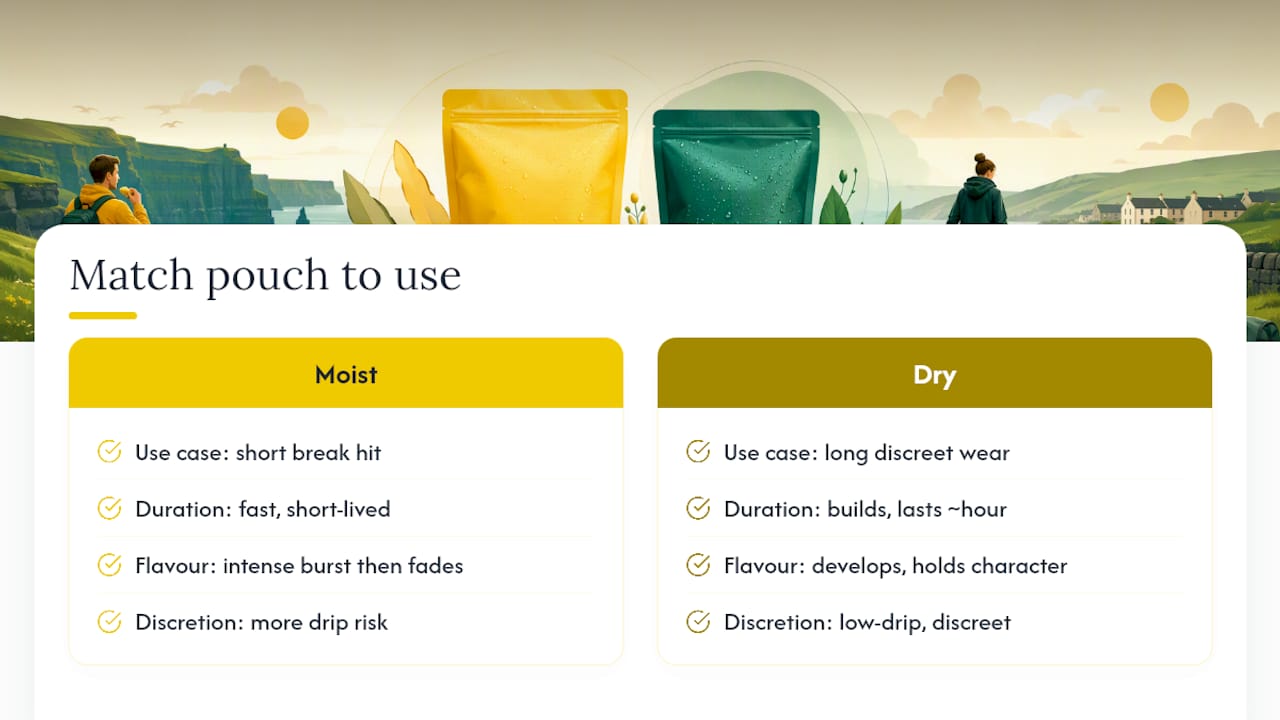
- Onset: Moist pouches hit within seconds to a minute; dry pouches need several minutes of saliva contact before you feel much.
- Flavour curve: Moist pouches front-load flavour and taper off; dry pouches build gradually and hold steadier for longer.
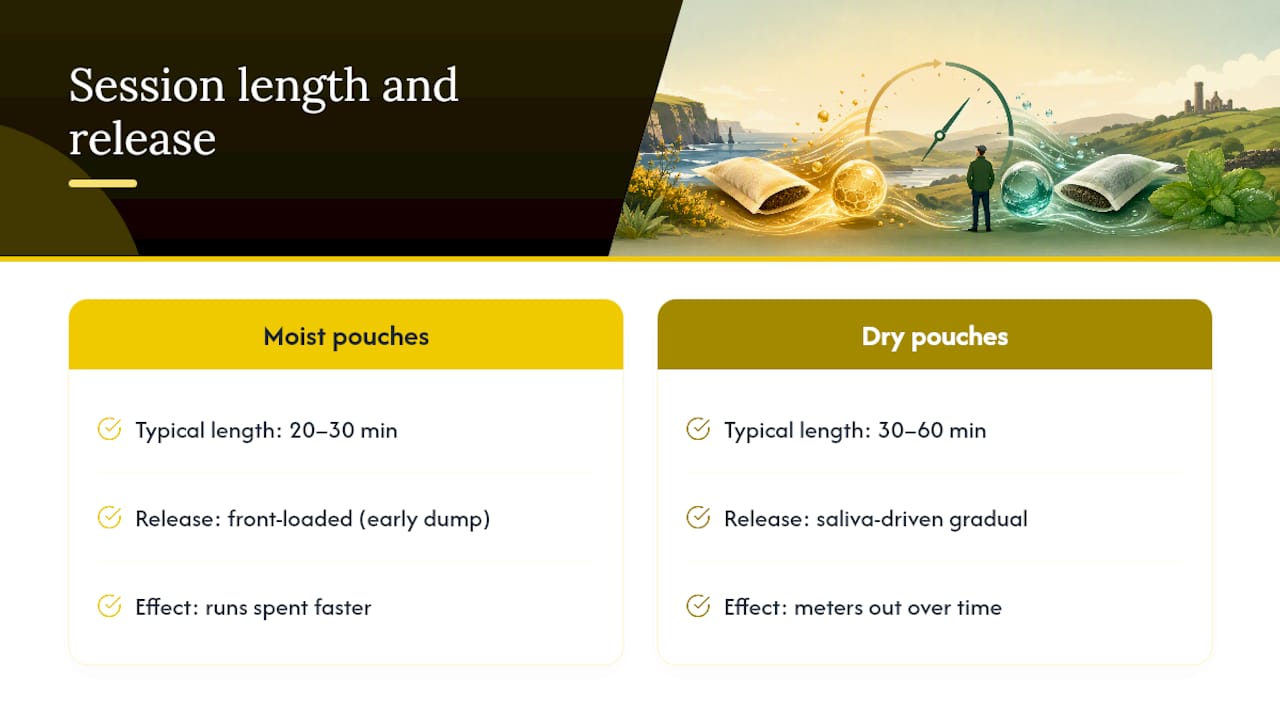
- Session length: Moist pouches often peak fast and fade within 20 to 30 minutes; dry formats can comfortably run 30 to 60 minutes.
- Drip: Moist pouches generate more saliva you’ll need to manage; dry pouches produce noticeably less.
- Discretion: Dry pouches sit flatter and quieter under the lip, which matters in meetings or on a packed train.
If you want something fast before a call, moist works. If you’re settling into a long meeting or a flight, dry is the more forgiving choice.
How moisture actually changes onset, flavour and nicotine release
A pre-moisturised pouch already has nicotine and flavour dissolved in liquid, so the moment it touches your lip, that dissolved payload starts migrating into your mouth. There’s no lag. A dry pouch, by contrast, is packed with far less free liquid. Your own saliva has to hydrate the plant fibre and filler before nicotine can dissolve and cross into the tissue lining your gum, which is why the first two to five minutes with a dry pouch can feel underwhelming compared with the moist alternative.
A characterisation study examining seven commercial pouch products measured moisture content ranging from low single digits at the dry end up to around 37% at the wet end, with clearly faster dissolution in several of the drier products and a much faster initial release in some of the wetter ones. That’s the lab confirmation of what users already notice by feel: wetter pouches surge, drier ones build.
The practical consequence is a different intensity curve rather than a different total dose. Moist pouches tend to peak early and decline steadily, so the last ten minutes feel noticeably weaker than the first five. Dry pouches spread that same nicotine content across a longer, flatter curve, which is partly why people describe them as “more consistent” even when the mg strength on the label is identical. If you’ve ever switched formats and felt like a 10mg pouch suddenly hit differently, moisture kinetics are usually the reason, not a mislabelled tin.
Why ‘strength’ can feel different even with the same mg
Two pouches can carry the same nicotine content and still feel worlds apart, because moisture isn’t the only variable doing work here. pH matters enormously. Nicotine exists in two forms inside a pouch: a protonated (bound) form and a free, unprotonated form. The free form crosses your oral tissue faster, so manufacturers adjust the pouch’s alkalinity to control how much nicotine sits in that faster-absorbing state at any given moment. CORESTA’s reference pouch specifications illustrate the range well: their dry reference product (NP1) sits around pH 8.25 with roughly 2.2% moisture, while their high-moisture reference (NP2) runs closer to pH 9.10 with about 47% moisture. Higher pH generally means more nicotine sits in that free, fast-absorbing form.
Filler solubility and particle properties add another layer. Some pouches use finer, faster-dissolving plant fibre; others use coarser material that releases more slowly regardless of moisture level. Research into dissolution profiles across commercial products links these physicochemical differences directly to how intense a pouch feels in practice.
The takeaway: don’t shop by mg number alone. A 10mg pouch with high pH and fine filler can feel stronger than a 14mg pouch with lower pH and coarser fibre. Trust your own experience over the label.
Managing comfort, drip and session length
Moist pouches saturate faster, and that saturation has to go somewhere, which is why they tend to produce more saliva. Most experienced users just swallow small amounts periodically rather than fighting it, and it becomes second nature within a few sessions. Dry pouches sidestep most of this because there’s less free liquid to begin with, which is exactly why they’re the better pick for meetings, flights, or anywhere spitting or swallowing constantly would be awkward.
- Dry pouches sit flatter against the gum, making them easier to forget about during long stretches.
- If a dry pouch feels weak in the first minute, that’s normal. Give it the full activation window before judging it.
- For moist pouches, positioning slightly further back from the front teeth reduces visible lip movement.
Pro Tip: Give any dry pouch a full two to five minutes before deciding it “isn’t working.” Pulling it early is the single most common reason people wrongly write off dry formats.
How moisture is measured, and what the numbers actually mean
Labs and manufacturers track two related but distinct figures. Oven volatiles (often just called moisture content) measures the percentage of water and humectants, such as glycerol or propylene glycol, driven off when a sample is heated. Water activity (aw) measures how much of that moisture is actually available for microbial growth, on a scale from 0 to 1.
Both matter for different reasons. Testing methodology from Pouch Aware explains that water activity predicts shelf stability and microbial risk, while total moisture better predicts how a pouch actually feels in your mouth. A product can carry moderate total moisture but a low water activity if much of that liquid is bound up in humectants rather than free water, which is one reason two “20% moisture” pouches from different brands can feel different. As a rough guide, products with moisture below single-digit percentages sit at the dry end, and those with moisture above low double digits start moving into distinctly moist territory, with some reference products having higher values. Higher water activity generally means the product needs tighter storage conditions to stay stable.
Choosing between dry and moist for your own use
Run through five questions before you commit to a tin:
- How fast do you want it to hit? Immediate, choose moist. Willing to wait a couple of minutes, dry works fine.
- How long do you want the session to run? Short and sharp favours moist; 30 to 60 minutes favours dry.
- How much drip can you tolerate? Low tolerance means dry is the safer bet.
- Does discretion matter right now? Meetings and flights favour the flatter, quieter dry format.
- What flavour experience do you want? A flavour burst that fades points to moist; a steadier, longer-held flavour points to dry.
The simplest way to test this without wasting a tin is to try one format in a low-stakes evening session, then try the other during something longer, like a work call or a commute. Judge onset speed, drip, and how the flavour holds up after twenty minutes, not just the first impression.
FUZE’s pouches are built around rapid, smooth release with low drip, and the range spans three flavours designed to hold their character for 30 to 60 minutes, which gives you a practical starting point for either preference without guessing across unfamiliar brands.
What ‘moist’ and ‘dry’ actually mean once the pouch is in your mouth
The labels describe the pouch’s water content before use, not a judgement on quality. A dry pouch feels almost powdery to the touch and starts out with little available liquid; a moist pouch feels noticeably damp and cool straight from the tin. That physical difference is what drives the activation gap.
With a dry pouch, the first sixty seconds can feel like nothing is happening. That’s expected. Saliva needs time to work through the fibre and dissolve the nicotine salts inside. Most users report the real onset somewhere between two and five minutes in, building gradually rather than announcing itself.
Moist pouches skip that waiting period entirely because the liquid, and everything dissolved in it, is already sitting on the surface fibre ready to transfer. You’ll usually notice flavour and a light tingle within the first thirty seconds. Some users find this immediacy reassuring, especially if they’re used to cigarettes or vapes where the hit is instant. Others find it too intense right out of the gate and prefer the dry format’s gentler ramp.
Neither activation pattern is objectively better. It’s a genuine preference split, and it’s worth deliberately trying both at least a few times before settling on one, because your first impression of a dry pouch (weak, slow, underwhelming) often flips completely once you’ve learned to wait it out.
Speed versus duration: the real trade-off in flavour and nicotine release
Every pouch delivers a finite amount of flavour and nicotine over its lifespan. The question moisture answers isn’t “how much” but “how fast, and spread over what window.” Moist pouches release a larger share of that payload in the opening minutes, which produces the sharp, satisfying front-loaded hit many users chase, especially when time is short.
Dry pouches spread the same delivery across a longer arc. The dissolution research on commercial pouch products found that drier products generally released their content more gradually and over a longer window than the wettest samples tested, which lined up with faster initial release in the higher-moisture products. That’s the physical basis for why a dry pouch under your lip at minute 40 can still be delivering noticeably more than a moist pouch would at the same point.
This is why picking a format isn’t really about picking a strength. It’s about picking a shape for the experience. If you want maximum intensity concentrated into a short window, say, a quick five-minute break, moist wins on that specific metric. If you want something that holds steady through a two-hour drive without needing a replacement, dry wins on that one instead. Trying to judge both formats by “which felt stronger in the first minute” will always favour moist, and that’s a misleading way to compare them if what you actually care about is the full session.
Why session length varies so much between formats
Session length differences come down to how much of the pouch’s total moisture and dissolved content gets used up early versus late. Moist pouches tend to feel “spent” faster, often somewhere between 20 and 30 minutes, because most of the readily available nicotine and flavour has already migrated out. Once that initial liquid reservoir is depleted, what’s left is comparatively inert.
Dry pouches, precisely because they rely on your saliva to continuously hydrate fresh material throughout the session, tend to keep releasing usable content for 30 to 60 minutes. There’s a rationing effect: the fibre only gives up what your saliva can currently dissolve, so the pouch effectively meters itself out over a longer stretch rather than dumping everything at once.
This has a practical knock-on effect for how often you’d reach for a fresh one. Someone who uses moist pouches through a working day will typically go through more of them than someone using dry pouches for the same total time, simply because each moist pouch runs its course faster. It’s worth factoring that into how you think about value, not just upfront preference, particularly if you’re buying in bulk or comparing tins by price per pouch rather than price per hour of use.
The chemistry beyond moisture: pH and nicotine form revisited in context
It’s worth returning to pH and nicotine form specifically in the context of choosing a pouch, because this is where users most often get confused comparing brands. Two tins can list the same milligram figure and still feel meaningfully different in your mouth, and moisture alone doesn’t explain that gap.
Formulators adjust alkalinity to shift how much nicotine sits in its free, fast-absorbing form versus its bound form. A higher-pH pouch pushes more nicotine into that readily absorbed state, which can make a lower-mg product feel punchier than a higher-mg one formulated at a lower pH. Reference specifications from CORESTA’s standardisation work put this in concrete terms, showing measurably different pH values attached to their dry and high-moisture reference products, underlining that pH and moisture are adjusted independently rather than moving together automatically.
Filler solubility and particle size add a further variable, since finer, faster-dissolving material tends to release nicotine more quickly than coarser blends regardless of how wet the pouch is. Put plainly: don’t shop purely by the number on the tin. If a switch between two “equivalent” mg pouches feels off, the difference is almost certainly sitting in pH or filler formulation, not a mislabelled dose. Judging by feel across a few sessions tells you more than the label ever will.
Matching the format to how you actually use pouches
The right choice isn’t really about which format is objectively better. It’s about matching moisture profile to the shape of your day. Someone who wants a fast, satisfying hit during a short break gravitates naturally towards moist pouches. Someone who needs something discreet and long-lasting through a three-hour meeting or a flight is far better served by dry.
Flavour preference plays into this too. If you love an intense burst that fades, moist delivers that experience honestly. If you’d rather have a flavour that builds patiently and holds its character for closer to an hour, dry is the format built for that. Neither preference is more “advanced” than the other. It’s genuinely just a personal fit question, similar to preferring an espresso hit versus a slow-drip coffee that lasts through a whole morning.
Context matters as much as personal taste. Commuting on a packed train favours the low-drip discretion of dry pouches. A relaxed evening at home removes most of the drip concern, so moist pouches can shine without any downside. Social settings where you’re talking constantly tend to suit dry better, since managing saliva while holding a conversation is awkward. If you’re still undecided, pick based on your most frequent use case rather than an occasional one. Whatever format handles your typical Tuesday best is usually the right long-term choice, even if the other format still earns an occasional look-in for specific situations.
For readers curious how pouches stack up against other nicotine formats entirely, it’s worth reading how snus compares with vaping before assuming pouches are the right category at all.
Author perspective: what customer feedback tells us about format preference
Most requests we hear aren’t about nicotine strength at all. They’re about texture and timing: people want a pouch that doesn’t drip through a two-hour meeting, or one that hits fast before a call. FUZE’s rapid-release, low-drip formulation exists because that trade-off between speed and comfort is what actually drives repeat preference, not the mg figure on the tin.
— FNGN
Which FUZE pouch matches your preference
If fast onset and a light touch matter most to you, BREEZE 10mg is built for exactly that profile, quick to activate without overwhelming drip.
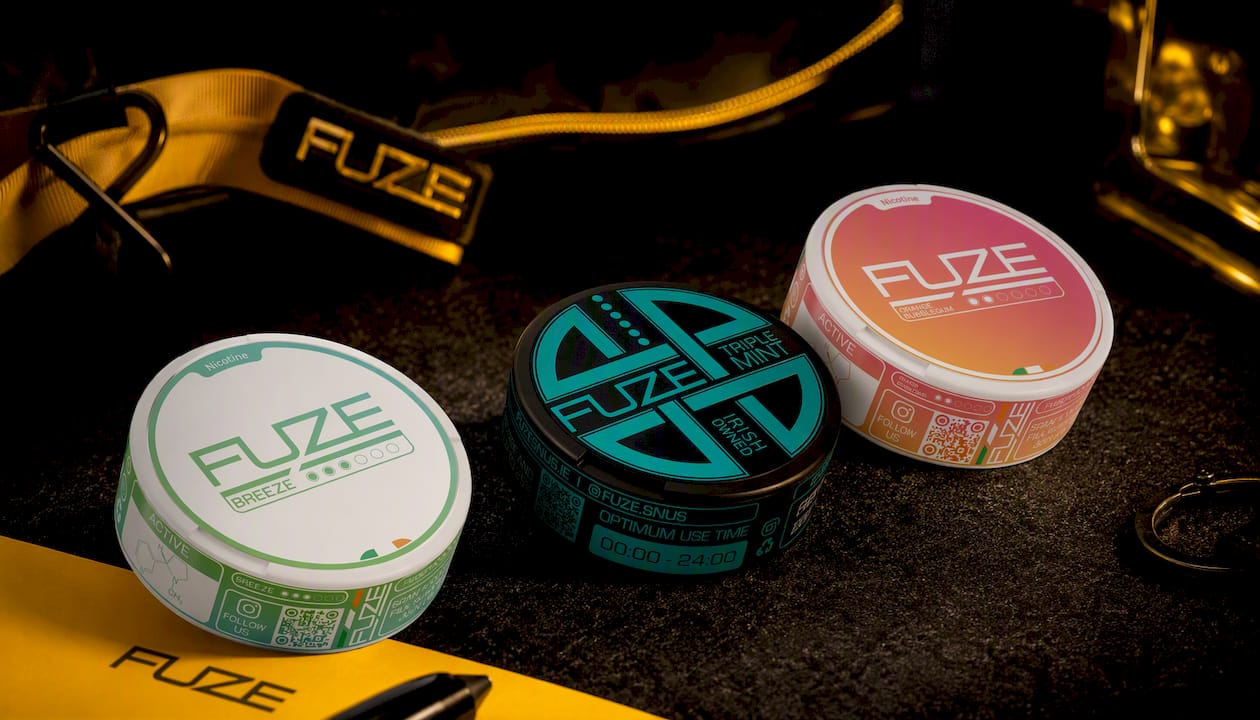
Want more nicotine and a flavour that holds through a long session? Triple Mint 20mg is the stronger option in the range, designed to sustain its character for 30 to 60 minutes rather than fading early. If you’d rather lead with flavour and keep the nicotine modest, Orange Bubblegum 8mg fits that lighter, flavour-first brief. All three are available for delivery in Ireland and internationally, with details available on the website. Pick the profile that matches your checklist above, order it, and judge it properly across a full activation window rather than the first thirty seconds. That’s the fairest test any pouch can get.
Sources
- Dissolution and physical characterization of oral nicotine pouch products - PMC
- Nicotine pouch reference products homogeneity and reference data — CTRP / University of Kentucky
- Testing explained — Pouch Aware