


How Many Pouches a Day for Adults? Measure mg, Not Count
Most adult users report between a few and over a dozen pouches a day, though the number that matters far less than how many milligrams of nicotine that adds up to. A pouch count on its own tells you almost nothing without knowing the strength, how long each one stays in, and your own tolerance. FUZE labels every product with a clear mg figure so you can work from the number that actually counts.
TL;DR:
- Pouch count alone is unreliable; focus on total daily nicotine intake by multiplying pouch strength in milligrams by how many you use.
- Using 10 pouches daily at 6mg each equals roughly 60mg of nicotine, while 6 pouches at 20mg delivers about 120mg, doubling exposure despite fewer pouches.
- Beginners should start with 1 to 3 low-strength pouches daily and gradually increase, spacing use to 30 to 60 minutes for safety and consistency.
- Signs of overuse include nausea, dizziness, rapid heartbeat, trouble sleeping, or growing cravings, which require stopping and possibly medical advice.
- Accurate labeling of pouch strength makes tracking nicotine intake possible; prioritize mg and spacing over pouch count for safer use.
Table of Contents
- How many pouches a day do people actually use?
- Why pouch count alone misleads you
- How many pouches should beginners and switchers try?
- Signs you are using too many
- What the evidence actually tells you to prioritise
- Choosing a FUZE pouch to match your daily mg target
- Sources
- FAQ
How many pouches a day do people actually use?
Surveys and community reports do not converge on one number. Industry data from Northerner shows clusters at 4 to 6 pouches a day among lighter users, with some survey averages running as high as 8 to 14 a day for heavier consumers. Self-reported figures on community forums land in a similar spread, with Reddit users describing daily counts ranging broadly. None of this is a target to hit. It is simply what gets reported when researchers or users ask.
A 2025 analysis of survey data in JAMA Network Open found that daily pouch use correlates strongly with prior use of cigarettes or e-cigarettes, and that daily use prevalence varies noticeably across demographic groups. In plain terms: someone switching from a 20-a-day smoking habit tends to land on a different daily count than someone who has never used nicotine before.
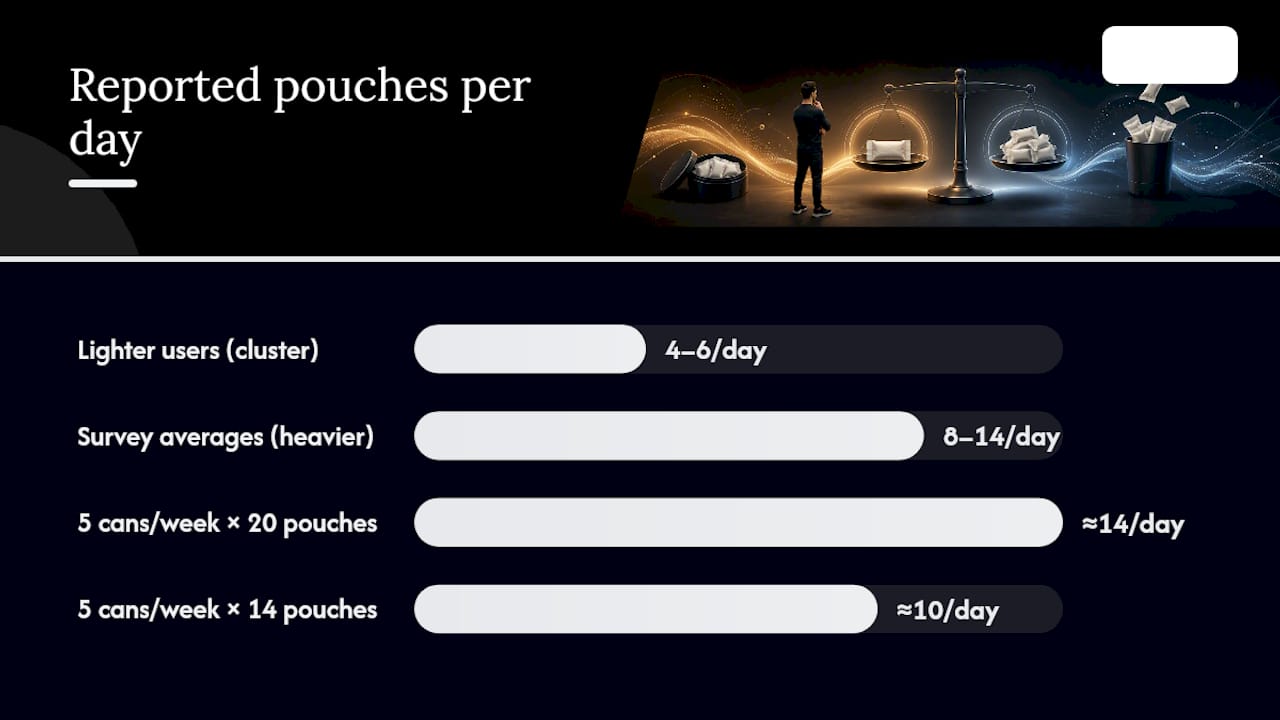
One figure worth remembering: a typical can contains a range of pouches, according to retail data reviewed by Northerner. That range is the reason “cans per week” is a poor way to estimate daily use unless you check the pouch count on the tin first.
Here is a worked example. Say someone gets through 5 cans a week, and each can holds 20 pouches:
- 5 cans × 20 pouches = 100 pouches a week
- 100 ÷ 7 days = roughly 14 pouches a day
Change the can size to 14 pouches instead of 20, and the same 5-can habit drops to around 10 pouches a day. The can count told you almost nothing until you knew what was inside it.
Why pouch count alone misleads you
Two people can both use “10 pouches a day” and have wildly different nicotine exposure. What actually matters is total daily nicotine, meaning pouch strength (mg) multiplied by how many you use, adjusted for how long each one sits in and how quickly it releases. Industry guidance consistently points to mg and spacing as the figures worth tracking, not the raw pouch tally, as Northerner notes.
Consider two scenarios:
- Ten pouches a day at 6mg each gives a daily total of roughly 60mg of nicotine.
- Six pouches a day at 20mg each gives a daily total of roughly 120mg, double the first person’s exposure despite using fewer pouches.
The second user might feel like they are being moderate because their pouch count is lower. They are not.
Pro Tip: Check the mg per pouch printed on the tin before you count anything else. Multiply that by how many you use in a day, then track that number, not the pouch count, week to week.
Use time matters too. A pouch left in for a full hour delivers more total nicotine than one swapped out after fifteen minutes, even at identical strength.
How many pouches should beginners and switchers try?
Where you start depends entirely on your history with nicotine, and there is no single correct pouch count that applies to everyone.
- New to nicotine: start at the lowest available strength and limit yourself to 1 to 3 pouches a day for the first week, watching for dizziness or nausea before increasing anything. Zero remains the only genuinely risk-free option if you are not already using nicotine.
- Switching from smoking: rather than copying a cigarette-per-cigarette count, work out your rough daily mg from cigarettes (a pack-a-day habit is a meaningful nicotine intake) and choose a strength and count that approximates it, then adjust after a few days based on how you feel. FUZE’s snus versus vape comparison is a useful reference if you are also weighing delivery methods.
- Regular users wanting to stabilise: pick one strength and hold your daily count steady for a week before judging whether to reduce, rather than adjusting daily based on cravings alone.
On pacing, keep a pouch in for around 30 to 60 minutes rather than swapping constantly, and leave a gap between pouches instead of using them back to back. Newcomers unsure of the mechanics can check FUZE’s guide on how to use a nicotine pouch for the basics.
Pro Tip: Keep a simple note on your phone: time, strength, and running daily total. Three weeks of this data tells you more about your real usage than any general guideline ever will.
No formal regulator publishes a maximum daily pouch number, and the most consistent advice from harm-reduction resources such as Calipouch is to use the fewest pouches at the lowest strength that still controls cravings.
Signs you are using too many
Your body tends to signal overuse well before anything serious develops. Watch for:
- Nausea or a queasy stomach shortly after using a pouch
- Dizziness or a mild headache that wasn’t there before you started
- A noticeably raised heart rate or palpitations
- Trouble falling asleep, especially if you are using pouches in the evening
- A growing sense that you need one sooner than you used to, which can signal building dependence
If any of these appear, stop using for the day, drink some water, and wait it out. Symptoms that are severe or do not settle, particularly palpitations or persistent dizziness, warrant medical attention rather than guesswork.
What the evidence actually tells you to prioritise
The conventional framing of “how many pouches a day” treats pouch count as if it were a dose. It isn’t. A pouch is a container, and the dose is whatever mg sits inside it, multiplied by how many you use and how long each one stays in. Advice that stops at a number of pouches, without asking what strength, is incomplete at best.
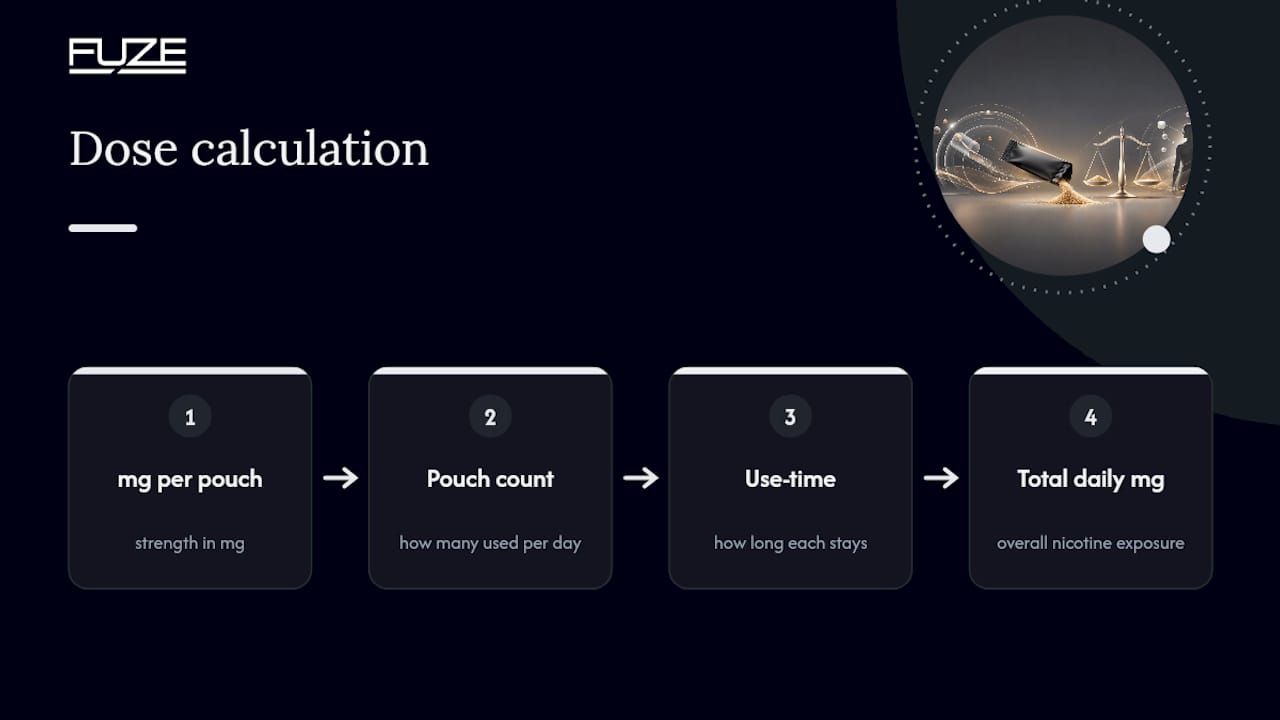
What the evidence supports is a hierarchy: strength and total daily mg first, spacing and use-time second, pouch count a distant third. Beginners get this backwards constantly, fixating on “how many is normal” when the more useful question is “how many milligrams am I taking, and does my body need that much.” Regular users who want to cut down make the same mistake, cutting pouch count while switching to a stronger tin and achieving nothing.
Clear labelling removes the guesswork. Knowing exactly what strength you are holding, every time, is what makes tracking possible at all.
— FUZE Team
Choosing a FUZE pouch to match your daily mg target
Once you know roughly what daily mg you are aiming for, picking a product becomes straightforward. FUZE’s three flavours, Triple Mint 20mg, Orange Bubblegum 20mg, and Red Lemonade 20mg, are all clearly labelled at 20mg per pouch, so there is no guessing involved in the maths.

Each pouch uses a design that delivers nicotine quickly and smoothly for between 30 and 60 minutes, which helps make estimating your daily total more reliable. If you are tracking mg per day, consistent release matters almost as much as the strength printed on the tin. Orders placed by the cut-off time may qualify for fast delivery, so working out your ideal daily count does not mean waiting days to put it into practice. Browse the full range on the FUZE site and pick the flavour and strength that fits the daily total you have worked out for yourself.
This article is general information, not a substitute for advice from a qualified doctor. Consult a qualified healthcare professional about your own circumstances before acting on anything here.
Sources
- How Many Nicotine Pouches Per Day Is Recommended? — Northerner
- How Many Nicotine Pouches Per Day Is Too Many? — Calipouch
FAQ
Are 2 nicotine pouches a day too much?
Two pouches a day is on the low end of reported use and is not inherently excessive, but the answer depends on strength. Two pouches at 20mg deliver considerably more nicotine than six at 6mg, so judge by total mg rather than the count alone.
How many snus pouches can you have a day?
There is no official maximum, but harm-reduction guidance from Calipouch recommends using the fewest pouches at the lowest strength that still manages cravings, which for many adults lands somewhere between 4 and 12 a day.
Is 20 snus a day a lot?
Twenty pouches a day sits well above the ranges most surveys report and, combined with almost any strength, typically represents a high daily nicotine total. If you are using anywhere near this many, tracking your daily mg and considering a reduction plan is worth doing sooner rather than later.
How long should 20 nicotine pouches last?
A tin generally holds between 14 and 25 pouches, so 20 pouches is roughly one tin. How long that lasts depends entirely on your daily count: someone using 4 a day gets five days from a 20-pouch tin, while someone using 10 a day gets through it in two.
Recommended
- Tobacco-free Snus (Nicotine Pouches) vs Vapes
- Vapes vs Snus ( Nicotine Pouches ) in Ireland
- What is a Snus | Nicotine pouch and how do I use it?
This is for general information purposes only, not medical advice. Please consult your doctor if you have medical queries. This article may not be fully accurate or fully researched. Please do your own research and consult professionals before using nicotine. Nicotine is an addictive substance.