


Avoid Nicotine Overdose: Swallowing Pouch Saliva Risks for Adults
For healthy adults, swallowing the small amount of saliva that builds up while using a nicotine pouch is generally safe. It won’t cause serious harm in most cases, though swallowing more than intended can increase your nicotine dose, particularly with stronger pouches. FUZE recommends starting low and paying attention to how your body responds.
TL;DR:
- Swallowing small amounts of saliva from nicotine pouches usually causes only mild, short-lived effects like nausea or hiccups in healthy adults.
- Discarded pouches contain residual nicotine capable of poisoning children or pets, making proper disposal essential for safety.
- Swallowing nicotine absorbed through the stomach increases total nicotine intake and can lead to serious toxicity if done frequently or with high-strength pouches.
- Symptoms of overdose include repeated vomiting, difficulty breathing, severe drowsiness, or seizures, requiring urgent medical attention.
- Proper pouch use involves still placement without chewing, limiting saliva production, and disposing of pouches immediately to reduce accidental ingestion risks.
Table of Contents
- What happens when you swallow saliva from a nicotine pouch
- How nicotine absorption changes when you swallow instead of just holding a pouch
- Symptoms to expect and when to seek medical help
- How to use a nicotine pouch correctly to cut down on saliva and accidental swallowing
- FUZE’s take on pouch design and safer use
- Try FUZE Triple Mint 20mg
- Sources
- FAQ
What happens when you swallow saliva from a nicotine pouch
Saliva that pools around a pouch isn’t plain spit. It carries dissolved nicotine and flavouring compounds released as the pouch sits under your lip. Swallowing a normal amount of that fluid during regular use produces, at most, mild and short-lived effects for most adults.
The usual sensations are nausea, a bout of hiccups, or a scratchy feeling at the back of the throat. These tend to pass within minutes and rarely need any intervention.
There’s an important distinction worth making here, though: swallowing saliva is not the same as swallowing the pouch itself. A pouch is a small fabric sachet filled with nicotine powder, fibre, and flavourings. Accidentally ingesting the whole thing is a different situation entirely, closer to swallowing a foreign object with an active substance inside it, and it deserves separate first-aid thinking rather than being lumped in with normal saliva.
Disposal matters just as much as usage technique. A used pouch still holds residual nicotine even after you’ve finished with it, and that’s precisely why it becomes a hazard once it’s out of your mouth and within reach of someone else:
- Discarded pouches retain enough nicotine to poison a child who picks one up.
- Most reported poisoning cases involve children under five years old, with ingestion the leading cause.
- Pets are equally at risk, since a dog or cat exploring a bin can just as easily find a used pouch.
How nicotine absorption changes when you swallow instead of just holding a pouch
Nicotine pouches are built for absorption through the lining of your mouth. That route delivers nicotine steadily into your bloodstream while the pouch sits in place, which is why the effect feels smooth and predictable across the 30 to 60 minutes a pouch lasts.
Swallowing changes that picture. Nicotine absorbed through the stomach and gut takes longer to reach the bloodstream than nicotine absorbed through the mouth, but it doesn’t disappear. It adds to whatever you’ve already absorbed orally, which means the total dose can climb higher than you intended, especially if you’re swallowing saliva throughout the entire time a pouch is in.
A documented risk, not a hypothetical one: a published case report describes acute nicotine toxicity linked to repeated pouch use, underlining that high or repeated doses can genuinely tip into serious toxicity rather than mild discomfort.
Nicotine content varies considerably between products, and the UK’s Committee on Toxicity has assessed how bioavailable that nicotine actually is, flagging that stronger products carry a higher toxicological risk when misused. A few patterns push that risk up noticeably: reaching for high-strength pouches before you’ve built any tolerance, using two or three at once, or deliberately gulping down saliva to chase a stronger hit. Each of those forces a larger nicotine load into your system faster than your body is used to handling.
Symptoms to expect and when to seek medical help
Mild symptoms from swallowing a bit too much saliva usually show up quickly and fade just as fast. Nausea, hiccups, and brief lightheadedness are the most common complaints, and they generally settle within an hour once you remove the pouch and give your body a chance to catch up.
Certain symptoms cross the line from uncomfortable to urgent. Watch for:
- Repeated vomiting that doesn’t let up
- Difficulty breathing or a tight chest
- Severe drowsiness or confusion
- Seizures or any loss of consciousness
If any of those appear, treat it as an emergency rather than something to sleep off. There’s no specific antidote for nicotine toxicity, so treatment relies on supportive care and monitoring, which is exactly why getting checked matters more than trying to wait it out at home.
Pro Tip: If you start feeling off, remove the pouch straight away, sip some water, and sit down for a few minutes before deciding whether you need to call a health line. Most mild reactions settle once the nicotine source is gone.
How to use a nicotine pouch correctly to cut down on saliva and accidental swallowing
Technique makes a bigger difference than most users expect. Where you place the pouch, how still you keep it, and how quickly you dispose of it afterwards all affect how much saliva you produce and how much nicotine ends up where you didn’t plan for it.
- Tuck the pouch under your upper lip and leave it there rather than moving it around with your tongue.
- Skip the temptation to chew it. Chewing releases nicotine faster and generates far more saliva than a pouch is designed to produce.
- Stick to one pouch at a time. Stacking two or three doesn’t make the effect better, just harder to control.
- If you’re new to pouches, start at a lower strength and build up only if you need to.
- If you start to feel queasy, take the pouch out before things get worse rather than trying to push through it.
- Bin used pouches straight away, ideally using a can with a catch lid, and keep that can somewhere children and pets can’t reach.
Pro Tip: Keeping still with the pouch in place, rather than shifting it about, is one of the simplest ways to reduce how much saliva builds up in the first place.
FUZE’s take on pouch design and safer use
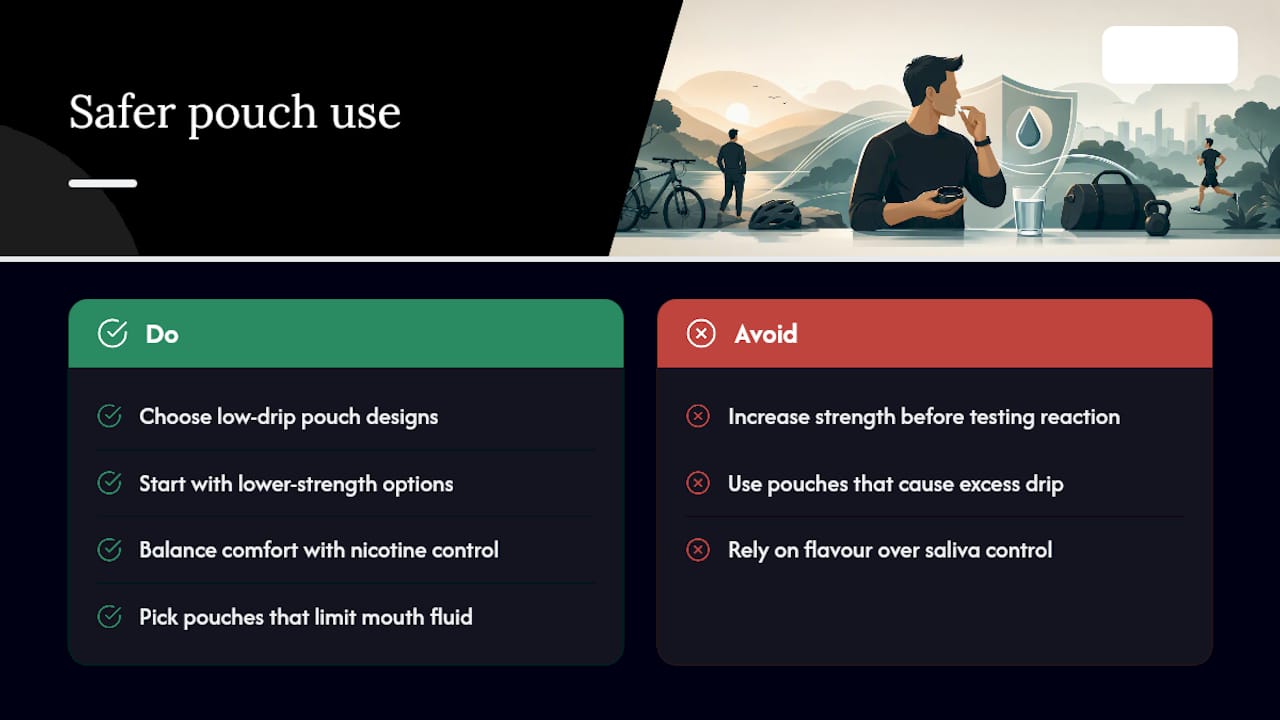
Some nicotine pouch brands design their products around rapid, smooth nicotine release specifically to cut down on the drip that causes most swallowing accidents in the first place. Low-drip technology is intended to reduce saliva pooling around the pouch, which may result in less accidental swallowing.
It is often advised that new users start with a lower-strength option and only increase strength once they understand how their body reacts. Comfort ideally should be balanced with control, and a pouch that delivers flavour and nicotine cleanly, without producing excess fluid in the mouth, can help maintain that balance.
— FUZE Team
Try FUZE Triple Mint 20mg
Certain nicotine pouch products offer low-drip, rapid-release options designed to reduce excess saliva during use.

For those interested, the Triple Mint 20mg pouch features a cooling mint profile and a 20mg strength typically suited for users with some nicotine experience. Store any pouches, used or unused, in a closed container well out of reach of children and pets. If you’re newer to pouches or unsure which strength fits you, it’s worth comparing options before committing to the higher-strength line. Some sellers offer same-day delivery on orders placed before 6pm in select counties, enabling customers to receive their products quickly.
Sources
For deeper reading on nicotine pouch safety, see the FDA’s storage and accidental exposure guidance, a peer-reviewed case report on acute nicotine toxicity, the University of Virginia’s toxicology brief on paediatric ingestions, and the Committee on Toxicity’s bioavailability statement.
This article is general information, not a substitute for advice from a qualified doctor. Consult a qualified healthcare professional about your own circumstances before acting on anything here.
- WebMD — consumer health overview
- FDA — Properly store nicotine pouches to prevent accidental exposure
- Case report of acute nicotine toxicity from nicotine pouches (PMC)
FAQ
Should I swallow nicotine pouch saliva?
Swallowing the small amount that naturally builds up during normal use is generally fine for healthy adults. If you notice a lot of saliva pooling, it’s better to swallow occasionally than to let it build up and gulp a large amount at once, which raises your nicotine intake more sharply.
Do you get more of a hit if you swallow the spit?
Swallowing does add extra nicotine to what you’re already absorbing through your mouth, since the stomach absorbs some of what’s dissolved in that saliva. It won’t hit as fast as oral absorption, but it can make the overall effect stronger and longer if you’re doing it repeatedly.
Does swallowing nicotine pouch saliva hurt your stomach?
Occasional swallowing during normal use isn’t typically associated with stomach damage. Some users report mild nausea afterwards, which usually settles on its own, though large or repeated doses can trigger more serious toxicity that goes beyond simple stomach upset.
Is using two pouches a day too much?
That depends entirely on the strength of the pouches and your existing tolerance. Two lower-strength pouches spread across a day is a very different exposure to two high-strength pouches used close together, so it’s worth choosing your strength deliberately rather than assuming a fixed number is automatically safe.
Recommended
This is for general information purposes only, not medical advice. Please consult your doctor if you have medical queries. This article may not be fully accurate or fully researched. Please do your own research and consult professionals before using nicotine. Nicotine is an addictive substance.